Founder planning instrument
Catalyze rough ideas into buildable SaaS plans.
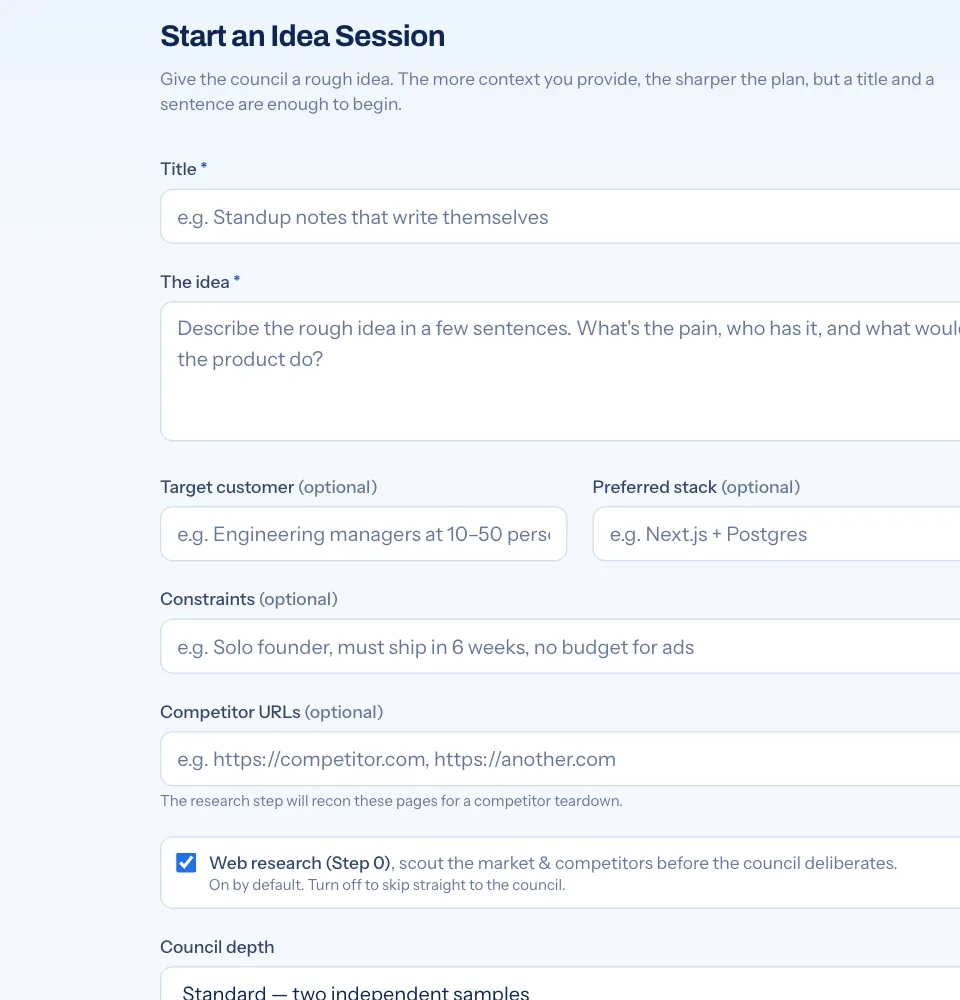
IdeaClyst sits Claude and Codex at the same table and lets them argue your idea into shape — then hands you a founder planning packet you can actually build from.
The skeptical founder
Pressure-tests the idea, finds the wedge, names the riskiest assumptions, and refuses to ship bloat.
The pragmatic CTO
Designs a lean, buildable MVP architecture and calls out anything technically naive in the plan.
One prompt gives you an answer. A debate gives you a plan.
Two different models, taking opposing roles and reading each other's work, produce a sharper plan than either alone. IdeaClyst orchestrates that debate and assembles the result — live, on your machine.
They critique each other
The founder attacks the architecture; the CTO attacks the strategy. Weak ideas don't survive the room.
No generic boilerplate
Every step is grounded in your idea, target customer, constraints and preferred stack.
A verdict, not a maybe
The final synthesis resolves disagreements with a clear recommendation you can act on.
Two minds. Opposing roles. One sharper plan.
Each agent plays a character with a job to do — and each reads what the other produced before responding.
The skeptical SaaS founder
Has seen ideas fail. Shapes the core problem and who feels it most, the sharpest wedge, willingness to pay, differentiation, go-to-market, and the assumptions that must be true — then critiques the architecture from a shipping lens.
The build-it-this-week engineer
Designs a lean MVP architecture — stack, data model, services, third-party APIs, build risks, sequencing — favoring shipping fast over completeness, then critiques the strategy from an engineering-reality lens.
Web research, then a five-step deliberation.
You submit an idea. It's grounded in live web data, then the council deliberates — each step's output appears the moment it completes.
Scout the market
Headless Chrome searches the web and recons competitors, grounding every later step in real data. Best-effort — never blocks a run.
Shape the strategy
Turns the raw idea into a credible product strategy and names the riskiest assumptions.
Design the MVP
Builds a lean, buildable architecture on top of the strategy — and flags anything naive.
Attack the architecture
From a product lens: what's over-engineered, what to cut to ship in weeks not months.
Attack the strategy
From an engineering lens: which assumptions are expensive or infeasible for an MVP.
Deliver the packet
Reconciles everything into one decisive founder planning packet.
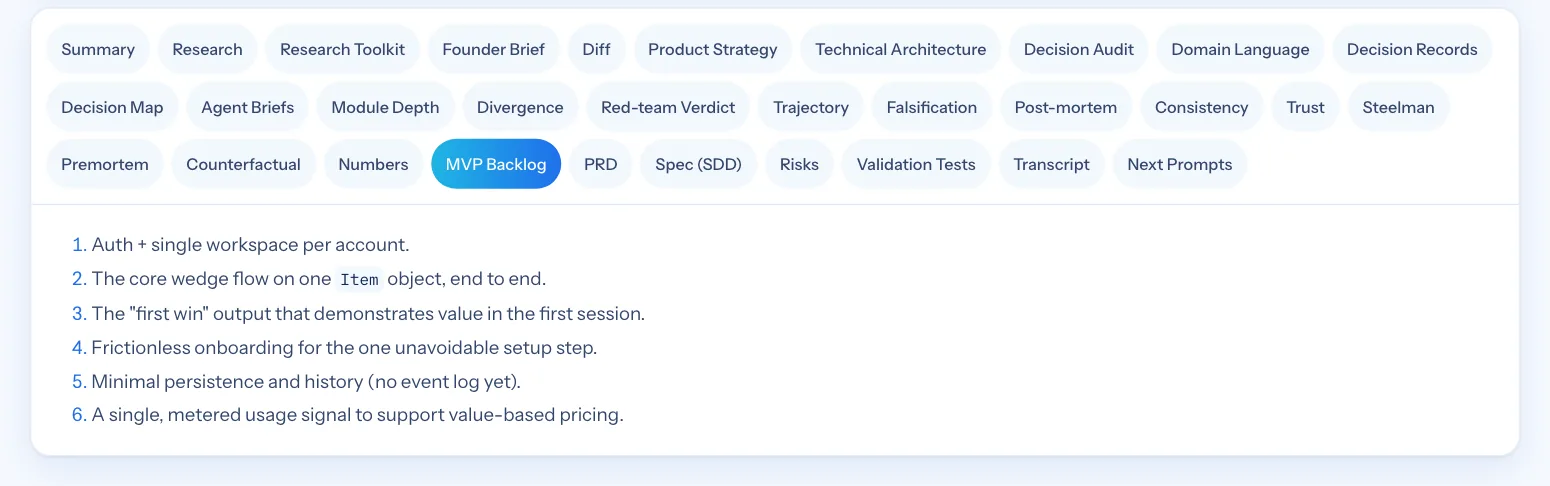
A founder planning packet, in five parts.
Not a wall of text — a structured packet, split into the sections a founder actually needs next.
Summary
The recommended product and approach, in a tight executive brief.
MVP Backlog
An ordered, buildable backlog of the smallest valuable first release.
Risks
The top risks and assumptions, each paired with a mitigation.
Validation Tests
Concrete experiments to validate the riskiest assumptions, with metrics.
Next Prompts
Ready-to-paste prompts to hand straight to an AI coding agent.
Every run also surfaces a live Research tab, the full Research Toolkit, and a one-page Founder Brief — all written to disk as Markdown too.
It does the homework — then hands you a toolkit.
A headless browser (vendored from surfagent) scouts the web before the council speaks, then turns the raw pages into structured founder tools — so the plan rests on real competitors and demand signals, not just the model's priors.
Market research
Searches the web and recons competitor pages, then feeds a cited research memo into every council step.
Research toolkit
Turns scraped sources into a sourced dossier, competitor matrix, opportunity map, validation experiments, distribution plan, kill criteria, MVP scope — and a one-page Founder Brief.
Competitor recon
Drop in competitor URLs and their pricing, features, and positioning are reconned into a teardown + comparison matrix.
Best-effort and offline-friendly — it degrades gracefully if a browser isn't available, so a run never fails. And you can rerun just the research layer anytime, without re-running the whole council.
No idea yet? It finds one for you.
The hardest part of building isn't judging an idea — it's finding one worth judging. Give IdeaClyst a market and it scouts the real web for problems people are actually complaining about, then proposes buildable candidates you can send straight to the council. Ideation grounded in demand signals, not a blank page.
Brief the hunt
Name a market — “visionOS apps,” “AI for accountants” — plus your goal (commercial, portfolio, learning…) and build capacity. These shape everything that follows.
Scout the web
Headless Chrome sweeps dedicated source lanes — Hacker News, Product Hunt, Reddit and GitHub — for problems, “I wish there was…” posts, and fresh launches, and maps them into an opportunity map (where pain is high and competition is low).
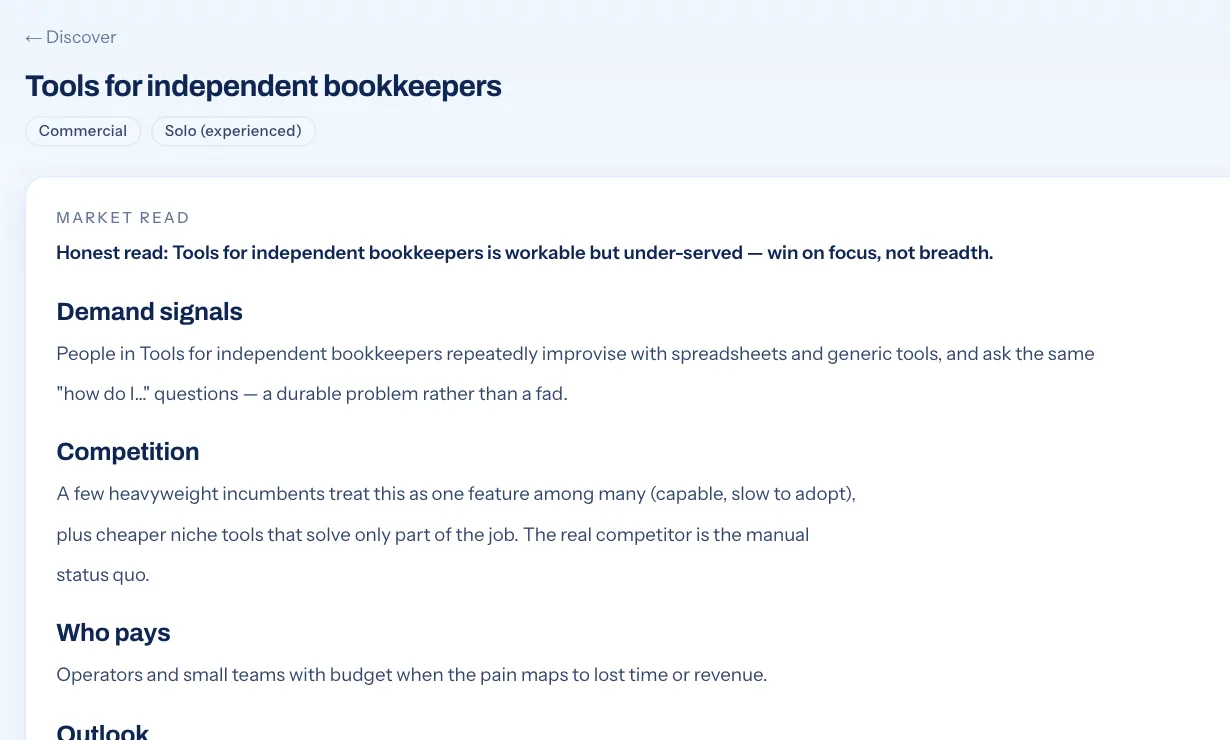
An honest landscape
First a sourced read of the space — a one-line verdict, demand signals, competition, who pays, and a realistic outlook for your goal. It leads with the bad news when the market is hard.
Ranked, comparable ideas
Then 5–7 concepts, best-fit first — each with a wedge, who pays, build effort, commercial strength, a transparent confidence score (demand, build-fit, monetization, novelty), explicit kill criteria, and the signal + source.
Open the full idea report
Every candidate gets an IdeaBrowser-style local report — scorecard, business fit, offer & value ladder, why-now, proof signals, market gaps, execution plan, framework fit, community & keyword intel, founder-fit, and an honest roast — with chat, personas, a funnel, version history, and one-click export.
Promote to council
One click turns a candidate into a full council run — carrying the report's thesis, founder-fit, core offer, and roast verdict into the brief, then running its own market research and 5-step deliberation.
Staged and progressive like a council run; mode-gated and best-effort — it always returns candidates and reports, even offline or when a source is walled.
A founder workspace — find, validate, build.
IdeaClyst doesn't stop at a plan. It's a local-first workspace that carries an idea from a demand signal all the way to a validation sprint and a build queue — every artifact on your own disk.
Founder profile & for-you fit
A one-time profile (skills, capital, time, risk tolerance, unfair advantages) personalizes discovery and adds a for-you rank and personal-fit lens to every idea report.
Library, compare & trend radar
Save ideas and reports to a local library, compare candidates side by side, get a daily idea pick, and watch a trend radar built from your own discoveries.
Validation & evidence tools
Turn a report's next actions, pricing hypotheses, and personas into a validation sprint board and interview list — and audit every claim in an evidence browser with source confidence.
Build workspaces & PRD queue
Each idea links to a minimum-viable funnel, buyer personas, a landing-page draft, a report chat, version history, and a build-this-idea page with a PRD and task queue ready for a coding agent.
Plus a decision log that becomes inspectable council memory, competitor/trend monitors, and research settings you can tune — all stored locally as JSON + Markdown.
Read a roadmap. Suggest what's next.
Point IdeaClyst at a Threlmark project — a local-first roadmap manager — and it reads the roadmap, finds the gaps, and proposes scored new features, spin-off products, and services, each grounded in real web research. Review them, then send the best back into Threlmark's inbox.
Your roadmap, read-only
Reads each Threlmark project straight off disk (or via its API) and builds a gap map — strong areas, thin or missing categories, done vs. still open — before anything runs.
Features, spin-offs, services
Three research lanes sweep the web and propose scored ideas — gaps into features, adjacency into spin-offs, productize into services — each with a why-now and real source links. Live and strict: real data only, never mock.
Back to your inbox
Review the suggestions, pick the keepers, and send them into the project's inbox — or cross-promote to another project. Provenance travels with every suggestion.
Your ideas stay on your machine.
Runs locally
Every run is stored on your own disk as run.json plus Markdown — no database, no cloud account.
No secrets handled
IdeaClyst never touches API keys. The Claude and Codex CLIs authenticate through their own local sessions.
Demo in seconds
A built-in mock mode produces realistic, idea-aware output with no CLIs installed — flip one switch for the real thing.
Catalyze your next idea.
IdeaClyst is open and local-first. Grab the code, run a council, and walk away with a plan.